Friday, September 19, 2014

Hyperfocal Distance Guide

The concept of hyperfocal distance is easy to understand: focus a lens at the hyperfocal distance and everything in the photograph from some near distance to infinity will be sharp. Landscape photographs are often taken with the lens focused at the hyperfocal distance; near and distant objects are sharp in the photos.
Application of the concept leads to many questions: Which lenses are best for using hyperfocal distance focusing? What is the hyperfocal distance for a lens? How do I focus at the hyperfocal distance? Do I have to focus exactly at the hyperfocal distance? In this article we'll look at the basics of using hyperfocal distance to maximize depth of field in a photograph.

Hyperfocal Distance Definition


Hyperfocal distance

When the lens is focused on the hyperfocal distance, the depth of field extends from half the hyperfocal distance to infinity. 
Photography, Phil Davis, 1972.


The hyperfocal distance is the point of focus where everything from half that distance to infinity falls within the depth of field.

John Shaw's Landscape Photography, John Shaw, 1994.

... the hyperfocal distance setting ... is simply a fancy term that means the distance setting at any aperture that produces the greatest depth of field.
How to Use Your Camera, New York Institute of Photography, 2000.


Choosing a Lens

Normal to wide-angle lenses (50mm and shorter lenses on 35mm cameras) are good candidates for hyperfocal distance focusing. These lenses have a relatively short hyperfocal distance when set to larger f-numbers. For example, the hyperfocal distance for a 28mm lens set to f/16 on a 35mm camera is about 5.5 feet. Everything from 2.75 feet to infinity will be sharp in a photograph taken with this lens focused at the hyperfocal distance.
Telephoto lenses are rarely used for hyperfocal distance focusing. The hyperfocal distance is quite distant with these lenses. For example, the hyperfocal distance for a 200mm lens set to f/16 on a 35mm camera is about 275 feet. Everything from about 138 feet to infinity will be sharp in a photograph taken with this lens focused at the hyperfocal distance. You can see that a 200mm lens isn't useful for taking a landscape photograph in which you want near objects to be sharp.


Calculating the Hyperfocal Distance

If you are fortunate enough to have a lens with a depth of field scale, you don't have to calculate the hyperfocal distance. Read the "Focusing on the Hyperfocal Distance" section below to learn how to use the scale.
You can calculate hyperfocal distance with the simple hyperfocal distance equation. It is a function of focal length, f-number, and circle of confusion (or, more precisely, the circle of least confusion.) However, you probably don't want to use the equation when you're out shooting. Instead, you can just use one of the many charts, tables of values, and software that are available. These tools will show the hyperfocal distance for a lens set to a particular f-number.
As stated above, hyperfocal distance is a function of the circle of confusion. You'll likely become bewildered by the many explanations for the circle of confusion. The debate over the "proper" circle of confusion has been raging for more than 70 years and will probably be raging forever.
Discussion of the circle of confusion is beyond the scope of this article. (See "Circle of Confusion" for an in-depth explanation.) However, I suggest that you use 0.030 mm for 35mm film. "Circles of Confusion for Digital Cameras" lists values for many cameras. This circle of confusion calculator is useful for calculating a value for other cameras.
Links to many sources are on the links page of this site. You can find dozens of charts, tables of values, and calculators on the internet by searching for "hyperfocal distance calculator" or "hyperfocal distance chart" on Google.Com.


The DOFMaster Hyperfocal Chart software for Windows operating systems prints hyperfocal distance charts.
The DOFMaster software for Windows operating systems emulates the depth of field scales that used to be engraved on lens barrels. It prints scales (circular slide rules) that you can take into the field. These scales provide a quick and easy way to find the hyperfocal distance for any lens and f-number combination.
The DOFMaster LE program for Palm devices is a easy-to-use program for calculating depth of field and hyperfocal distance in the field. This on-line depth of field calculator also calculates hyperfocal distance.

Focusing on the Hyperfocal Distance

You must focus the lens at the hyperfocal distance after deciding on a lens focal length and f-number combination that yields the hyperfocal distance you need. This is easy to do when the lens has a distance scale and a depth of field scale. But, many modern lenses don't have a distance scale and most don't have useful depth of field scales. Methods for focusing with these lenses are explained below.
It is important to note here that you should not change the focus after the lens has been focused at the hyperfocal distance. When you look though the viewfinder of an SLR camera you'll see that the near objects aren't sharp when the lenses is focused at the hyperfocal distance. The reason is that the lens aperture is wide-open. The depth of field you see in the viewfinder is not that same as that produced by the lens when it stops down to take the picture. You may be able to see what depth of field will be produced by the lens if your camera has depth of field preview.
It is common for beginners to adjust the focus to get near objects in focus when they look through the viewfinder. Have confidence that objects from half the hyperfocal distance to infinity will be acceptably sharp in the photographs and avoid the temptation to change the focus.


Three methods for focusing at the hyperfocal distance are explained below:
  • When the lens has a distance scale and a depth of field scale
    Hyperfocal scale on a lens

    This picture shows the depth of field scale on a lens. There are color-coded indexes for each f-number on each side of the focus index.
    Focusing the lens on the hyperfocal distance for a particular f-number is easy: set the f-number index on one side of the depth of field scale under the infinity symbol on the distance scale. The lens will be focused on the hyperfocal distance for the corresponding f-number. The depth of field will range from half the hyperfocal distance (which can be read from the distance scale at the focus index) to infinity.
    The lens in the picture above is focused on the hyperfocal distance for f/16. The cyan-colored index for f/16 to the left of the focus index is placed under the infinity symbol on the distance scale. The cyan-colored index for f/16 to the right of the focus index is located at about 9 feet on the distance scale. The focus index is at about 18 feet. So, for this example, the hyperfocal distance is about 18 feet, and the depth of field ranges from about 9 feet to infinity when the lens is set to f/16.
    The picture below illustrates how to focus the lens at the hyperfocal distance for f/8 and f/16.
    animated depth of field scale

  • When the lens has a distance scale but doesn't have a depth of field scale
    Hyperfocal scale on a lens

    This picture shows the distance scale on a 28mm-80mm zoom lens for a 35mm camera. The lens is set at the 28mm focal length.
    Follow these steps to focus on the hyperfocal distance with lenses similar to the lens in the picture:
    • Calculate the hyperfocal distance for the lens focal length and aperture. The picture below shows how to use DOFMaster to calculate the hyperfocal distance for the 28mm lens at f/5.6, using 0.025mm for the circle of confusion. Notice that the scales in DOFMaster work in the same manner as the scales on the lens described above. The index for f/5.6 on the right side of the focus index is placed under the infinity symbol. The hyperfocal distance (18 feet) is read from the distance scale at the focus index. The near limit of acceptable sharpness (9 feet) is read from the distance scale at the f/5.6 index to the right of the focus index.
      DOFMaster depth of field scale for a 28mm lens
    • Focus the lens at the hyperfocal distance as shown in the picture. For the 28mm lens at f/5.6, the hyperfocal distance is about 18 feet. The depth of field will range from half the hyperfocal distance to infinity.
    The distance scales on lenses rarely show the exact hyperfocal distance on which you need to focus. For example, the scale shown above shows only 4 feet, 5 feet, 7 feet, 10 feet, 20 feet, and infinity. You must estimate where the hyperfocal distance lies on the scale. See "The Theory of Depth of Field Scales" for a description of how distances are marked on a scale. It's best to focus a little beyond the hyperfocal distance if you aren't sure where the hyperfocal distance is on the distance scale; see "Estimating Hyperfocal Distance in the Field" below for an explanation of why this is so.
  • When the lens doesn't have a distance scale
    Many lenses don't have distance scales. Here's how to focus those lenses at the hyperfocal distance:
    • Calculate the hyperfocal distance for the lens focal length and aperture. The picture below shows how to use DOFMaster to calculate the hyperfocal distance for a 50mm lens at f/16, using 0.025mm for the circle of confusion. The hyperfocal distance for this example is about 21 feet.
      DOFMaster depth of field scale for a 50mm lens
    • Focus the lens on an object (the ground, a tree branch, your ten-year-old child who didn't run when you picked up the camera, etc.) at the hyperfocal distance. Focus a little beyond the hyperfocal distance if you aren't sure of your estimating abilities. Stop down one stop (e.g., estimate for the hyperfocal distance for f/16, and stop the lens down to f/22) to give yourself a little leeway. See "Estimating Hyperfocal Distance in the Field" below for more details.

Measuring Hyperfocal Distance In the Field

You don't have to measure to the hyperfocal distance when your lens has a distance scale. As described above, you can just set the lens focus index opposite the distance on the scale. With other lenses you'll have to measure to the hyperfocal distance so you'll know where to focus. You can also just estimate the distance as described in the next section of this article.
Use of a tape measure is the only accurate way to measure to the hyperfocal distance from the camera position. As you usually won't have a tape measure in the field, you probably can't accurately measure the exact hyperfocal distance. Besides, hyperfocal distance calculated using formulas is just a reasonable estimate for real photographic lenses. The hyperfocal distance equation is derived from the "thin-lens" equation, which assumes a single-element lens with no thickness. It doesn't apply exactly to any real photographic lens.
You don't have to focus the lens exactly at the hyperfocal distance. Focus the lens as best you can, and focus it slightly beyond the hyperfocal distance if you are unsure of your estimating abilities. Say, for example, focus at about 15 feet when the hyperfocal distance is 12.2 feet. Then, stop down one stop (e.g., from f/11 to f/16) to get a little more depth of field. See "Estimating Hyperfocal Distance in the Field" below for more details.
Here are two ways to measure from the camera positon to the hyperfocal distance in the field:
  • Focus a pocket rangefinder on an object at the hyperfocal distance. Then, focus your lens there.
    Laser rangefinders are available but are usually too expensive to buy just for photographic work. Also, most of the laser rangefinders don't measure distances that are commonly used for hyperfocal distance focusing.
    From the 1930s into the 1960s, many vendors made pocket rangefinders that can be used to measure distances. While these rangefinders aren't manufactured today, they can be purchased on eBay for $15-$20US. A Hugo Meyer pocket rangefinder is pictured below. Search eBay for "pocket rangefinder", "pocket range finder", and "Kodak service rangefinder" to look for these devices.
    Pocket rangefinder
  • Use this simple distance meter to measure the hyperfocal distance. It's just a triangular piece of cardboard that you calibrate for your eyes by marking distances on it. Using this device is probably a little better than just estimating the distance.

Estimating Hyperfocal Distance in the Field

You can just estimate the measurement to the hyperfocal distance when your lens doesn't have a distance scale and you don't have a means of measuring to it. Fortunately, the hyperfocal distance is near the camera position for normal and wide-angle lenses. So, you should be able to estimate the distance with sufficient accuracy.
By using your knowledge of the length of many things, you can make some decent estimates of distance in the field. For example, I can estimate distances of about 25 feet and 40 feet with some accuracy because of my familiarity with the width and length of my house. My car is about 12 feet long, so I use that knowledge (e.g., "that's about a car length away") to estimate the focus distance.
Use your best estimate of where the hyperfocal distance is from the camera position and focus your lens there. Then, apply these rules to give yourself some leeway:
  • Everything from at least one-half the focus distance to infinity will be in the depth of field when the lens is focused beyondthe hyperfocal distance.
  • It's better to focus beyond the hyperfocal distance than to focus in front of it when estimating the focus point.
  • Stop down one stop from the f-stop you used to calculate the hyperfocal distance.
Let's see how these rules apply to focusing a lens for hyperfocal distance photographs.
Everything from at least one-half the focus distance to infinity will be in the depth of field when the lens is focused beyond the hyperfocal distance. The actual near limit of acceptable sharpness will be less than 1/2 the focus distance. Say, for example, the hyperfocal distance is 12.3 feet for f/8 and your lens' distance scale shows 7 and 15 feet. Focus the lens at 15 feet. Everything from at least 7.5 feet to infinity will be in the depth of field. Note that for this example you'll have given up, at most, 1.4 feet of the depth of field (15/2 - 12.3/2 = 1.4). Stop down one stop to f/11 to include the extra 1.4 feet in the depth of field.
It's better to focus beyond the hyperfocal distance than to focus in front of it when estimating the focus point. The far objects won't be sharp if you focus in front of the hyperfocal distance. Say you have a 35mm camera with a 50mm lens set to f/8. The hyperfocal distance for this example is 12.2 feet. Everything from at least 7.5 feet to infinity will be sharp when the focus point is 15 feet . The depth of field ranges from about 5.5 feet to 50 feet when the focus point is at 10 feet; objects beyond 50 feet won't be sharp.
Stop down one stop from the f-stop you used to calculate the hyperfocal distance. For example, focus at the hyperfocal distance for f/11 and set the lens f-stop to f/16. Stopping down brings the near distance of acceptable sharpness closer to the camera position. Stopping down will generally give enough extra depth of field to account for any focusing or estimating errors.

Using Hyperfocal Distance in the Field - An Example

Here's how I set the focus point for this photograph of Lake McDonald:
Photograph of Lake McDonald, Glacier National Park
Lake McDonald, Glacier National Park
Copyright 2002 Don Fleming
I didn't have a depth of field scale or hyperfocal distance table for the Canon G2 lens (zoomed to 8mm). However, I knew that at f/8 the hyperfocal distance was something less than 10 feet. So, I set the focus to 10 feet. By focusing beyond the hyperfocal distance I knew two things. First, the depth of field would extend to infinity. Second, everything beyond 1/2 the focus distance (everything beyond 5 feet in this case) would be sharp.
According to the depth of field scale for the G2 lens, the actual depth of field is 3 feet to infinity for the 8mm lens set to f/8 and focused at 10 feet. The hyperfocal distance is 4.5 feet. If I had focused at exactly the hyperfocal distance, the depth of field would have ranged from 2.25 feet to infinity. So, in actual practice I lost about 9 inches of foreground sharpness by focusing at 10 feet. Those 9 inches aren't even in the photograph.

Conclusion

Remember that hyperfocal distance is just a reasonable estimate for actual photographic lenses. Focus a little beyond the hyperfocal distance and you'll know that everything from at least 1/2 the focus distance to infinity will be acceptably sharp in the photo.
The answers to the questions posed in the introduction are:
How do I calculate the hyperfocal distance, or where do I find a table or chart of hyperfocal distances for my lenses? Calculate it using the hyperfocal distance equation, use the DOFMaster calculators (links at left), use one of the many calculators on the internet, or download a chart or table from the internet.
What are the best lenses and f-stops to use? Normal to wide-angle lenses (50mm or shorter lenses for 35mm format) and relatively large f-numbers (small apertures) will yield a hyperfocal distance that is near to the camera.
How do I focus at the hyperfocal distance? Try one of these methods.
How do I focus at the hyperfocal distance when my lens doesn't have a depth of field scale or a distance scale? Try this method.
Do I have to focus exactly at the hyperfocal distance? No. Make your best estimate of where the hyperfocal distance is from the camera position. Focus a little beyond the hyperfocal distance, and everything from at least 1/2 the focus distance to infinity will be acceptably sharp in the photograph. Stop down one stop to give yourself some leeway.
**Source: copied from ~ http://www.dofmaster.com/hyperfocal.html#focusing

 *******************************************

Wednesday, February 26, 2014

Common Errors in English Usage

http://public.wsu.edu/~brians/errors/errors.html#errors

Monday, December 9, 2013

Fifth Freedom Flights

In the unofficial “Freedoms of the Air,” the fifth freedom is the ability for a carrier of Country A to carry passengers on an international route solely between Country B and Country C when on a multi-leg flight that involves Country A. This is usually because of a necessitated stopover — the distance between Country A and Country C is too far, so a stopover is made in Country B. Other times, it’s to help combine traffic for multiple countries, such as Brussels Airlines West Africa routes. The carrier is allowed to carry passengers between A-B, A-C, and B-C.
An example of this is the Kangaroo route between London and Sydney. This route is too long for any carrier to fly nonstop, so historically, a stop has been made somewhere in Asia. British Airways flies London to Sydney via Singapore, and carries passengers from London to Singapore, London to Sydney, and Singapore to Sydney. That last example is a fifth-freedom route, since a UK-based carrier is carrying passengers between Singapore and Australia.


HOW CAN THIS BENEFIT ME?

Often times, fifth-freedom carriers will serve a certain destination pair with much larger aircraft than the home carriers will. Let’s go back to the example of Auckland – Sydney. This route is served by Australia-based carriers like Virgin Australia and Qantas as well as Air New Zealand. The aircraft on this route include narrow-bodies like the Boeing 737, Airbus A320, and some Boeing 767 and Boeing 777 on certain flights.
However, it’s also served by Dubai-based Emirates, which flies the route with its Airbus A380 and Chile-based LAN, which flies the route with its Airbus A340. Emirates tags Sydney-Auckland to the end of its Dubai-Sydney flight, while LAN tags Auckland-Sydney to the end of its Santiago-Auckland flight.
If you want to fly between Sydney and Auckland, you can book a ticket on Emirates or LAN, even though neither is based in either country. Fifth freedoms are how I flew the Emirates A380 in First Class between Hong Kong and Bangkok (for only a few hundred dollars more than coach!). Emirates is partners with Korean Air, which is a partner of Chase Ultimate Rewards. You can book the AKL-SYD flight in Business for 25,000 Ultimate Rewards points transferred to Korean Skypass one-way, or 37,500 points in First.  LAN’s long-haul business class is also a great product, and their A340s are much wider than the Boeing 767s they fly on most North American routes. Lastly, because LAN is a member of OneWorld, you can use your American AAdvantage miles or British Airways Avios to fly them (and LAN doesn’t charge fuel surcharges)!

EK F suite
Emirates A380 First Class suite from Hong Kong to Bangkok
Earlier this year, I needed a random one-way segment from Hanoi to Bangkok. Neither is a OneWorld hub, so I couldn’t use Avios without a connection (which would raise the price, as well as the travel time). The cheapest ticket was on AirAsia, but for $5 more, I could buy a ticket on Qatar Airways. Hmm, an A320 on a low-cost carrier that will charge me for everything, or a Boeing 777 on “the world’s 5-star airline?” Easy decision.
Lastly, fifth-freedom flights can give you the ability to check out a carrier you otherwise would not usually fly. Bangkok-Hong Kong is replete with unique airlines from Africa, Middle East, and Indian Ocean areas (as you’ll see below).


WHAT ABOUT OTHER CITIES?

My “secret tool” for learning about fifth freedom carriers on a route I want to fly is Google.
Just go to Google.com and type in”flights from AAA to BBB,” where AAA and BBB are the airport codes of the cities you want to fly. For Sydney to Auckland, you’ll see some usual suspects, plus LAN, Emirates, and China Airlines.
SYD-AKL 5thfreedom

One problem here is that if you make “AAA” an airport within the USA, Google will return a slightly different looking results page, which isn’t as straightforward as before. For example,”flights from LAX to LHR” returns this, with a Lufthansa codeshare (which is actually the United flight) and Transaero codeshare (which is the Virgin Atlantic flight):

LAX-LHR 5thfreedom

The fix to this is to just search the reverse, to make the origin outside the USA: “flights from LHR to LAX,” which shows the true airlines flying this route (the usual suspects, but also Air New Zealand, which flies LAX to LHR after it’s flight from Auckland). Often times, the flight FROM the US is simply one flight number off of the flight TO the US.

LHR-LAX 5thfreedom

One slight drawback to this is that Google will only return the upcoming schedule of flights, so if a route is seasonal for an airline, it may not show up.


SO CAN I FLY QANTAS FROM NEW YORK TO LA?

Aha, so you’ve somehow discovered Qantas 108 (it’s delayed again today, living up to its name as “QF 1-oh-late”). Unfortunately, this isn’t a valid fifth freedom route, because New York and LA are in the same country. Qantas is only allowed to fly passengers on this route who are continuing on to a Qantas flight to Australia.
It’s the same situation down under, where United has a flight between Sydney and Melbourne, but can only carry passengers that it brought from the United States on flights from Los Angeles or San Francisco. All of this is due to rules against “cabotage” — a foreign carrier may not carry passengers solely between two domestic points.
However, British Airways flies routes within South Africa, but those are actually operated by Comair, an airline based in South Africa as an affiliate of British Airways. These intra-South Africa flights are a great use of Avios!

THEN WHAT ARE SOME INTERESTING FIFTH-FREEDOM ROUTES?

This isn’t an exhaustive list, just ones I think are interesting (due to interesting routes or cool aircraft on that route, in addition to being able to earn/burn useful miles). Keeping up-to-date is tough, as I try to look at route maps every few months, but if you know of a fifth freedom that’s not on the list, let me know! In future posts, I’ll talk about how you can use these routes to maximize award redemptions with these routes.
Last Updated: May 29, 2013 (Thai LAX-KIX, Ethiopian LFW-GIG-GRU-LFW)


OneWorld


airberlin

Abu Dhabi – Phuket

British Airways

Singapore – Sydney
Colombo-Male
Doha – Bahrain
Abu Dhabi – Muscat
Antigua – Saint Kitts
Antigua – Tobago
Antigua – Punta Cana
Antigua – San Juan
Nassau – Grand Cayman
Nassau – Providenciales
Saint Lucia – Port of Spain
Saint Lucia – Grenada

Head For Points points out that you can redeem these routes with Avios at the Reward Saver Level for a cheaper way to sample British Airways in a premium cabin.
British Airways affiliate Sun-Air of Scandinavia flies the following routes, redeemable at the Reward Saver Level:
Aalborg – Oslo
Aarhus – Gothenburg
Aarhus – Oslo
Aarhus – Stockholm (BMA)
Billund – Bergen
Billund – Brussels
Billund – Düsseldorf
Billund – Munich
Billund – Oslo
Billund – Stockholm (BMA)

While not necessarily fifth freedom routes, British Airways affiliate Comair flies domestic routes within South Africa that can be booked with Avios.

Cathay Pacific

Vancouver – New York JFK
Bangkok – Singapore
Bangkok – Mumbai
Bangkok – Delhi
Bangkok – Karachi
Bangkok – Colombo
Singapore – Colombo
Taipei – Tokyo
Taipei – Seoul
Taipei – Osaka
Taipei – Fukuoka


Iberia

San Salvador – Guatemala City

LAN

(LAN is based in Chile, but has subsidiaries in Peru, Argentina, Colombia, and Ecuador, so I don’t consider routes in those countries)
Auckland – Sydney
Madrid – Frankfurt
Miami – Punta Cana
Miami – Caracas
(discontinued) New York – Toronto (I mention this because it would’ve been SWEET with Avios)

Malaysia Airlines

Los Angeles – Tokyo

QANTAS

Singapore – London (until April 2013)
Singapore – Frankfurt (until April 2013)
Dubai – London (from April 2013 onward)


Royal Jordanian

Bangkok – Kuala Lumpur
Bangkok – Hong Kong


Qatar Airways (expected OneWorld in October 2013)

Buenos Aires – Sao Paulo
Budapest – Zagreb
Baku – Tbilisi
Bucharest – Sofia
Johannesburg – Maputo
Kigali – Entebbe
Kuala Lumpur – Phuket
Bangkok – Hanoi – trip report
Bangkok – Ho Chi Minh City
Singapore – Denpasar


SriLankan (expected OneWorld in 2013)

Bangkok – Hong Kong
Bangkok – Guangzhou
Bangkok – Shanghai
Bangkok – Beijing


Star Alliance


Air Canada

Buenos Aires – Santiago

Air China

Madrid – Sao Paulo
Munich – Athens


Air New Zealand

Los Angeles – Rarotonga, Cook Islands
Los Angeles – London
London – Hong Kong (discontinued March 2013)


Brussels Airlines

(by no means do I think this one is exhaustive, since they have an interesting African route map, but these ones actually showed as bookable for the future)
Abidjan – Monrovia
Bamako -> Ouagadougou (only one-way. and you’re doing a disservice to yourself if you fly this and don’t hike the Dogon Country in Mali, near the border with Burkina)
Freetown -> Banjul
Conakry -> Banjul


COPA

San José (Costa Rica) – Guatemala City
Managua – Guatemala City
San José – Managua
San Pedro Sula – San José
Tegucigalpa – San José


EgyptAir

Bangkok – Kuala Lumpur

Ethiopian

Lomé – Rio de Janeiro (787) begins July 1, 2013 (via GRU eastbound)
Lomé – Sao Paulo (787) begins July 1, 2013 (via GIG westbound)
Bamako – Dakar
Bujumbura – Kigali
Cotonou – Abidjan
Malabo – Douala
Kigali – Entebbe
Delhi – Hangzhou, China
Bangkok – Hong Kong (until June 17, 2013)
Bangkok – Kuala Lumpur
Cairo – Stockholm


EVA Air (expected Star Alliance member in 2013, current partner with United)

Bangkok – Amsterdam
Bangkok – London Heathrow
Bangkok – Vienna


Lufthansa

Ho Chi Minh City – Bangkok
Kuala Lumpur – Bangkok
Baku – Ashgabat


Singapore Airlines

Manchester – Munich
Los Angeles – Tokyo (A380)
San Francisco – Seoul
San Francisco – Hong Kong (A380 until March 24, 2013)
Houston – Moscow
New York – Frankfurt (A380 resumes on March 25, 2013)
Sao Paulo – Barcelona (no fuel surcharge from Brazil, and only 59K SQ miles one-way for First)
Dubai – Cairo


South African Airways

Accra – Abidjan
Washington DC – Dakar


SWISS

Dubai – Muscat

THAI

Karachi – Muscat
Hong Kong – Seoul
Taipei – Seoul
Taipei – Hong Kong
Los Angeles – Seoul
Los Angeles – Osaka (KIX)


Turkish

Bishkek – Ulaanbaatar
Bahrain – Muscat
Djibouti – Mogadishu (which led to one of the more interesting Mileage Run deals)
Ho Chi Minh City – Bangkok
Sao Paulo – Buenos Aires


United

Koror (Palau) – Manila
Koror – Yap (Micronesia)
Tokyo – Guam (not really a 5th freedom, but still interesting. United has an extensive hub at Narita that serves other Asian destinations)
The Island Hopper: Honolulu to Guam via Majuro, Kwajalein, and the Caroline Islands
Kuwait – Bahrain
Dubai – Doha. In case Emirates and Qatar go bankrupt or something.


Skyteam


Air France

Los Angeles – Papeete

China Airlines

Rome – Delhi
Amsterdam – Bangkok
Brisbane – Auckland
Sydney – Auckland
Singapore – Surabaya
Hong Kong – Jakarta
Hong Kong – Bangkok


China Eastern

Colombo – Malé

Delta

Amsterdam – Mumbai
Tokyo – Koror (Palau)
Tokyo – Saipan (not really a 5th freedom but the only carrier on this route)
Delta also has a hub at Tokyo Narita for flights into Asia.

Kenya Airways

Bangkok – Hong Kong (ends March 30th, 2013)
Dubai – Hong Kong (begin March 31st, 2013)
Bangkok – Guangzhou


Koninklijke Luchtvaart Maatschappij (KLM)

Dammam – Kuwait
Doha – Muscat
Singapore – Denpasar
Kuala Lumpur – Jakarta


Korean Air

Los Angeles – Sao Paulo
Los Angeles – Tokyo (ends March 30th, 2013)
Honolulu – Tokyo (begins March 31st, 2013)
Vienna – Zurich


Mileage Earning Non-Alliance Carriers


Emirates (partners with Korean Air, JAL, and Alaska Airlines)

Buenos Aires – Rio de Janeiro
Colombo – Singapore
Colombo – Malé
Kuala Lumpur – Melbourne
Singapore – Melbourne
Bangkok – Sydney
Bangkok – Hong Kong (A380)
Singapore – Brisbane
Brisbane – Auckland
Sydney – Auckland (A380)
Melbourne – Auckland (A380)
Sydney – Christchurch
Harare – Lusaka
Accra – Abidjan
Malta – Larnaca


Etihad (partners with American Airlines)

Beijing – Nagoya
Singapore – Brisbane


Jet Airways (partners with American, United, and US Airways)

Newark – Brussels
Toronto – Brussels


Published December 28, 2012 by Amol
Source: http://hackmytrip.com/2012/12/taking-advantage-of-fifth-freedom-flights/

The Ultimate Guide to United Miles

All The Ways to Get to Japan, North Asia & South Asia!


The Best Tip for Searching on United.com

Don’t forget to change your search results to show you 50 flights (instead of the default) when you search on United.com

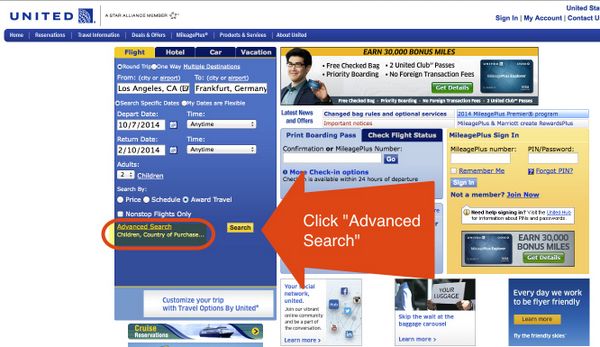
Step 1 – Click On “Advanced Search”

Click on “Advanced Search” at the bottom of the award search page.
United Asia Miles
Step 1 – Click on “Advanced Search”

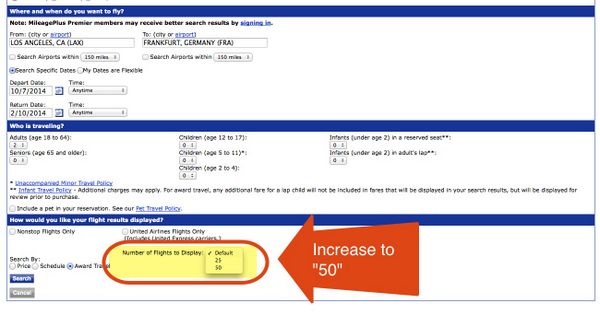
Step 2 – Change “Number of Flights to Display” To “50″

Click on the drop-down box by the “Number of Flights to Display” and change it from the “Default” to “50
United Asia Miles
Step 2- Increase the Number of Flights to Display to 50
You will see MANY more flight options this way!

How To Use The Information In This Post

You could rely on United.com to find you awards seats to Japan, North Asia, and South Asia.  And United’s website is pretty good.  But it is unlikely to find every possible option on using United miles to Japan, North Asia, and South Asia.
If you’re really commited to finding award seats to Japan, North Asia, and South Asia and don’t want to hire an award booking service, you could search for award seats on many of the routes below.
The information below will help you find the long-distance flight to Japan, North Asia, and South Asia.  Once you find the long-distance flight to Japan, North Asia, and South Asia, you should start searching for flights to your final destination in Japan, North Asia, and South Asia and then from your US departure city to the gateway (i.e. where the flight to Japan, North Asia, and South Asia departs from the US).

Asia Award Routes

Today we will go over finding award flights to Asia, which includes the regions of:
  • Japan
  • North Asia, including China, Mongolia, South Korea, and Taiwan
  • South Asia, including Bangladesh, Bhutan, Brunei, Cambodia, Hong Kong, Indonesia, Laos, Macau, Malaysia, Myanmar (Burma), Philippines, Singapore, Thailand, and Vietnam.
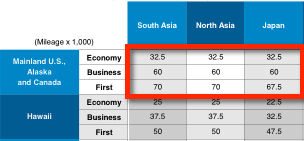
Here is the award chart which shows the number of miles needed from the United States to Asia.
United Asia Miles
Asia Award Chart
Here’s how much you will pay from the U.S., Alaska, and Canada to Japan:
  • 32,500 miles each way in economy class (22,500 miles from Hawaii)
  • 60,000 miles each way in business class (32,500 miles from Hawaii)
  • 67,500 miles each way in first class (47,500 miles from Hawaii)
Here’s how much you will pay from the U.S., Alaska, and Canada to North Asia or South Asia:
  • 32,500 miles each way in economy class (25,000 miles from Hawaii)
  • 60,000 miles each way in business class (37,500 miles from Hawaii)
  • 70,000 miles each way in first class (50,000 miles from Hawaii)

1.   United

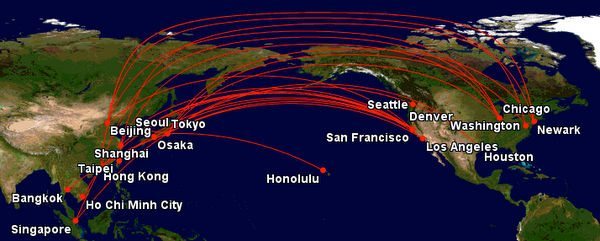
Of all the airlines based in the USA, United has the most routes to Asia!
You can fly from:
United Asia Miles
United Flies To Many Cities In Asia!
  • San Francisco (SFO) to Beijing, Hong Kong, Osaka, Seoul, Shanghai, Tokyo (Narita), Taipei (starts March 31, 2014)
  • New York/Newark (EWR) to Beijing, Hong Kong, Shanghai, Tokyo (Narita)
  • Chicago (ORD) to Beijing, Hong Kong, Shanghai, Tokyo (Narita)
  • Los Angeles (LAX) to Shanghai, Tokyo (Narita)
  • Washington, DC (IAD) to Beijing, Tokyo (Narita)
  • Houston to Tokyo (Narita)
  • Denver to Tokyo (Narita)
  • Seattle to Tokyo (Narita)
  • Honolulu to Tokyo (Narita)

1.  From Tokyo (Narita)

As you can see from the map above, every airport listed has a flight to Tokyo (Narita), where United operates its Asia hub.
Onward from Tokyo (Narita), United flies to:
  • Bangkok
  • Hong Kong
  • Seoul-Incheon
  • Singapore

2.  From Hong Kong

United also flies onward from Hong Kong to:
  • Ho Chi Minh City
  • Singapore

2.  Air Canada

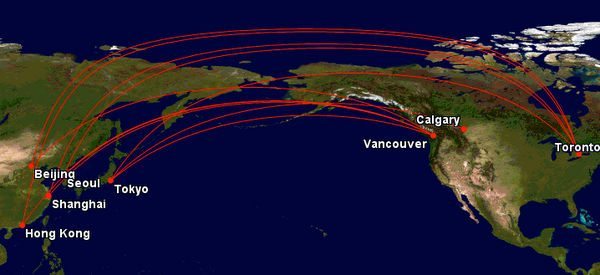
Air Canada has flights to several Asian destinations, all from both Toronto (YYZ) and Vancouver (YVR) airports.  This is useful for flights to/from Canada, and also useful for many people in the US, because you can connect in Canada on the way to Asia.
You can fly to:
United Asia Miles
Air Canada’s Flights To Asia
  • Beijing from Vancouver and Toronto
  • Hong Kong from Vancouver and Toronto
  • Seoul-Incheon from Vancouver and Toronto
  • Shanghai from Vancouver and Toronto
  • Tokyo (Narita) from Vancouver, Toronto, and Calgary

3.  Air China

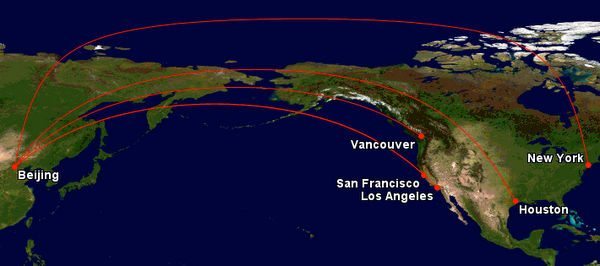
Air China is based in Beijing, and flies from there to several cities in the USA and Canada.
You can fly to Beijing from:
United Asia Miles
You Can Fly On Air China To Beijing From Houston, Los Angeles, New York, San Francisco, And Vancouver
  • Houston
  • Los Angeles
  • New York (JFK)
  • San Francisco
  • Vancouver
From Beijing, Air China has decent connections to other places in China, as well as Southeast Asia.

4.   ANA

ANA is one of Japan’s national airlines.  They are based in Tokyo (Narita), but also fly internationally out of Tokyo-Haneda (which is closer to the center of Tokyo).
ANA recently started flying from San Jose, California to Tokyo (Narita).  Flights from San Jose tend to have more award seats because very few flights from the East Coast and the rest of the US connect in San Jose.
ANA flies from Tokyo (Haneda) to Los Angeles.
You can fly from Tokyo (Narita) to:
United Asia Miles
You Can Fly On ANA From Tokyo To Chicago, Los Angeles, New York, San Francisco, San Jose, Seattle, And Washington
  • Chicago (ORD)
  • Los Angeles (to Tokyo (Narita) and Tokyo (Haneda)
  • New York (JFK)
  • San Francisco
  • San Jose, CA (SJC)
  • Seattle
  • Washington, DC (IAD)
ANA has many onward connections to the rest of Asia.

5.  Asiana

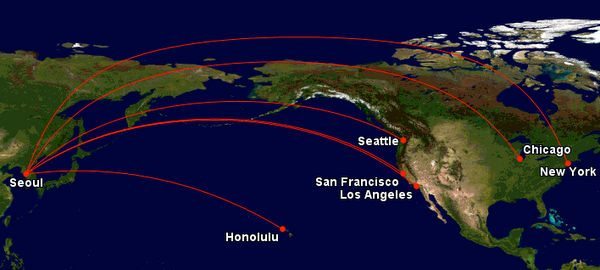
Asiana is one of the major airlines in South Korea.
You can fly internationally out of Seoul-Incheon airport to:
United Asia Miles
From Seoul, You Can Fly On Asiana To Chicago, Honolulu, Los Angeles, New York, San Francisco, And Seattle
  • Chicago (ORD)
  • Honolulu
  • Los Angeles
  • New York (JFK)
  • San Francisco
  • Seattle
From Seoul, Asiana flies to many Asian destinations.

6.  EVA Air

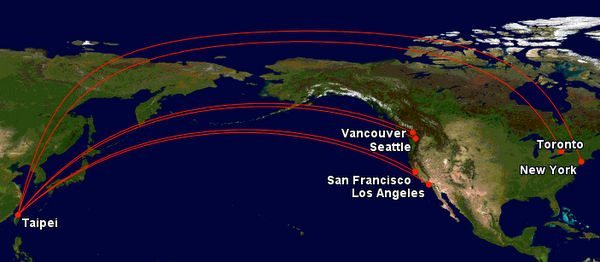
EVA Air is the newest member of the Star Alliance (as of June 2013).  They are based in Taipei and fly to several US and Canadian destinations.
You can fly from Taipei to:
United Asia Miles
You Can Fly On Eva Air From Taipei To Los Angeles, New York, San Francisco, Seattle, Toronto, And Vancouver
  • Los Angeles
  • New York (JFK)
  • San Francisco
  • Seattle
  • Toronto
  • Vancouver
EVA Air has many onward and convenient connections into Southeast Asia.

7.  Singapore Airlines

Singapore Airlines is the national airline of Singapore.  Many people love Singapore Airlines because they have great service, especially in First and Business Class, and even in economy class!  Their main airport, Singapore Changi airport, is one of the best in the world, with butterfly gardens, koi ponds, and free movie theaters!
Unfortunately, Singapore Airlines knows how much people love to fly them, and so they don’t tend to offer First and Business Class award seats to people with United miles.
But, Singapore Airlines economy class seats are available with United miles on flights from the United States.
Singapore Airlines flies from:
United Asia Miles
Where You Can Use Your United Miles On Singapore Airlines
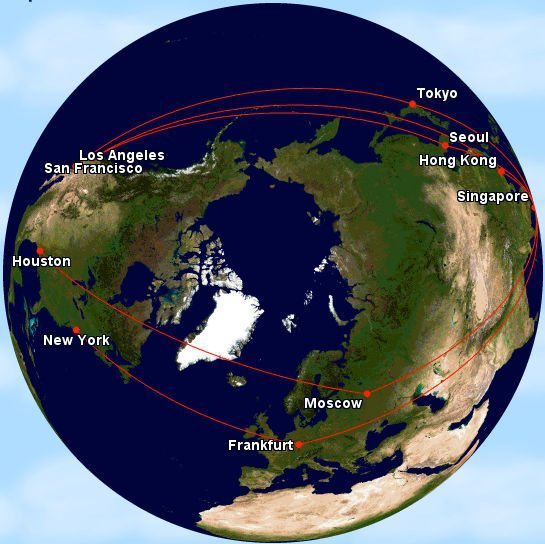
  • Houston to Moscow to Singapore
  • Los Angeles to Tokyo (Narita) to Singapore
  • New York-JFK to Frankfurt to Singapore
  • San Francisco to Seoul-Incheon to Singapore
  • San Francisco to Hong Kong to Singapore
Keep in mind that you are allowed to book an award to just the connecting point on these flights.  For example, if you wanted to fly just from Los Angeles to Tokyo, you can fly on Singapore Airlines even if you don’t book your ticket all the way to Singapore.
Singapore Airlines has a lot of onward connections from Singapore to the rest of Southeast Asia, as well as Australia and South Asia.  Those regional routes tend to have Business Class award seats available.

8.  Thai Airways

Thai Airways is based in Bangkok and usually has a lot of award availability.  If you fly out of Bangkok on Thai in First or Business Class, you even get a 30-minute or 1-hour massage before your flight!
However, they only fly to one North America city – Los Angeles.  Outside of this route, Thai is generally useful if you want to fly intra-Asia, between Asia and Europe, or between Asia and Australia.
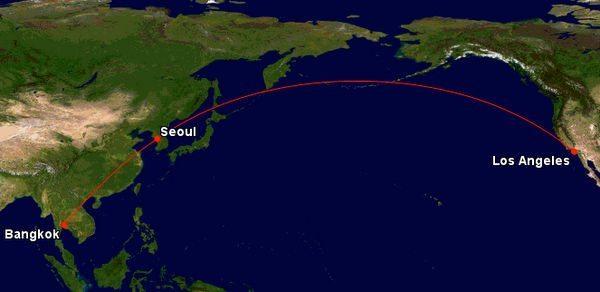
Thai flies from Los Angeles to Bangkok via Seoul-Incheon.  If you only want to fly Los Angeles to Seoul, you are allowed to book just that portion.
United Asia Miles
You Can Fly On Thai Airways From Los Angeles To Bangkok With A Connection In Seoul
TIP:  When booking award seats on Thai Airways flights for multiple people, you might see only 2 seats available.  Try holding or booking the first 2 seats, then see if Thai opens up more seats afterward.  Often, Thai Airways will only release 2 award seats at a time.

Flying To Asia Via Europe

You can use your United miles to fly from North America to Asia via Europe.
This is huge, because it also allows you to have a stopover in Europe on the way to Asia, if you book your trip as a round-trip.
We discussed how to find award space from North America to Europe in Part 8: All The Ways To Get To Europe! 

After reviewing that previous post, we will now have to see how to connect Europe and Asia on our award ticket!

Restrictions On Segments When Flying To South Asia Via Europe

Before we begin, you should know the restrictions on awards between the US and South Asia that connect in Europe
  • On a one-way ticket you are allowed only 4 segments from your origin city to your destination.
  • On a round-trip ticket you are allowed only 5 segments each way from your origin city to your destination.
Let’s say you wanted to fly from Chicago to Singapore via Europe on a one-way ticket. You are allowed to book Chicago-Frankfurt-Istanbul-Bangkok-Singapore, because that has 4 segments (3 connecting cities).  However, you are not allowed to book Chicago-Boston-Frankfurt-Istanbul-Bangkok-Singapore because that has 5 segments to South Asia via Europe on a one-way award.
On a round-trip ticket, you could book Chicago-Boston-Frankfurt-Istanbul-Bangkok-Singapore, but only if you book a return.

Which Airlines Fly Between Europe And Asia?

The following is a list of airlines that fly between Europe and Asia.  Cities that are international Star Alliance hubs are bolded.  These hubs tend to have many connection opportunities from partner flights.

1.  Air China

You can fly to Beijing, Shanghai, and/or Chengdu from:
United Asia Miles
Cities In Europe Where You Can Connect To An Air China Flight
  • Athens (to Beijing via Munich)
  • Dusseldorf (to Beijing)
  • Frankfurt (to Beijing, Shanghai, and Chengdu)
  • Geneva (to Beijing)
  • London-Gatwick (to Beijing)
  • London-Heathrow (to Beijing)
  • Madrid (to Beijing)
  • Milan (to Beijing and Shanghai)
  • Moscow (to Beijing)
  • Munich (to Beijing)
  • Paris (to Beijing and Shanghai)
  • Rome (to Beijing)
  • Stockholm (to Beijing)

2.  ANA

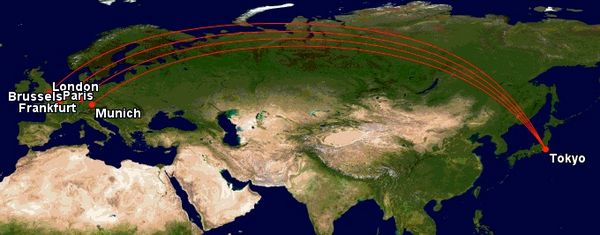
You can fly to Tokyo (Narita) and/or Tokyo (Haneda) from:
United Asia Miles
The Cities Where You Can Connect In Europe To Fly ANA To Tokyo.
  • Brussels (to Narita)
  • Frankfurt (to Narita and Haneda)
  • London-Heathrow (to Narita)
  • Munich (to Narita)
  • Paris (to Narita)

3.  Asiana

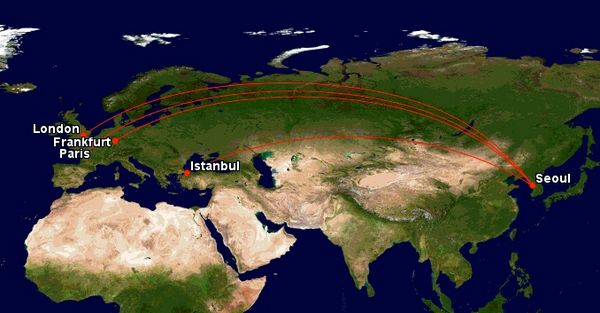
You can fly to Seoul-Incheon from:
United Asia Miles
The Cities In Europe Where You Can Connect To An Asiana Flight To Seoul
  • Frankfurt
  • Istanbul
  • London-Heathrow
  • Paris

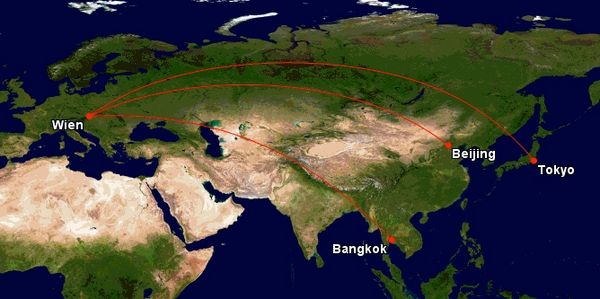
4.  Austrian

You can fly from Vienna to:
United Asia Miles
You Can Connect In Vienna To Fly Austrian To Bangkok, Beijing, Or Tokyo
  • Bangkok
  • Beijing
  • Tokyo (Narita)

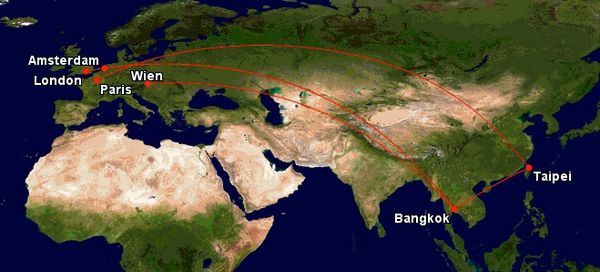
5.  EVA Air

You can fly to Taipei and Bangkok from:
United Asia Miles
You Can Connect In These Cities To Fly EVA Air To Taipei Or Bangkok
  • Amsterdam (via Bangkok)
  • London-Heathrow (via Bangkok)
  • Paris
  • Vienna (via Bangkok)

6.  LOT Polish Airlines

You can fly from Warsaw to:
United Asia Miles
LOT Flies From Warsaw To Beijing
  • Beijing

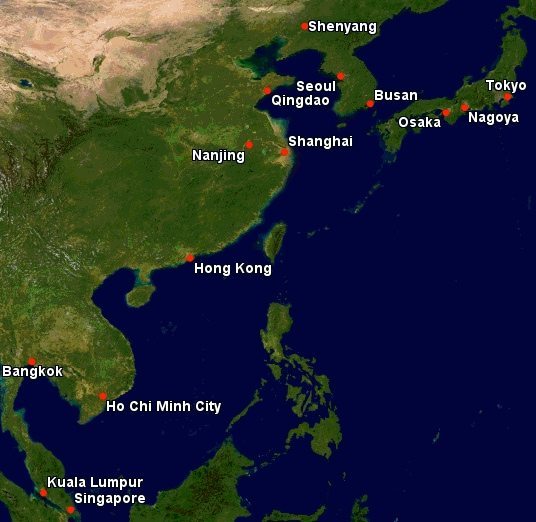
7.  Lufthansa

You can fly from Frankfurt and/or Munich to:
United Asia Miles
You Can Connect In Frankfurt And Munich To Fly Lufthansa To These Asian Cities
  • Bangkok
  • Beijing
  • Busan (via Seoul)
  • Ho Chi Minh City (via Bangkok)
  • Hong Kong
  • Kuala Lumpur (via Bangkok)
  • Nagoya
  • Nanjing
  • Osaka
  • Qingdao
  • Seoul
  • Shanghai
  • Shenyang
  • Singapore
  • Tokyo (Narita)

8.  Scandinavian (SAS)

You can fly from Copenhagen to:
United Asia Miles
You can connect in Copenhagen to fly SAS to Asia.
  • Bangkok
  • Beijing
  • Shanghai
  • Tokyo (Narita)

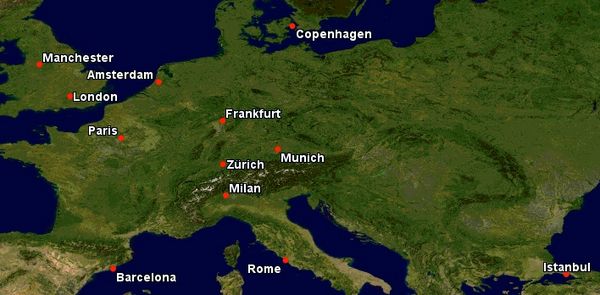
9.  Singapore Airlines

Singapore Airlines has mostly economy class award seats available to Singapore from:
United Asia Miles
You Can Connect In These European Cities To Fly Singapore Airlines To Singapore
  • Amsterdam
  • Barcelona (sometimes via Milan)
  • Copenhagen
  • Frankfurt
  • Istanbul
  • London-Heathrow
  • Manchester (via Munich)
  • Milan
  • Munich
  • Paris
  • Rome
  • Zurich

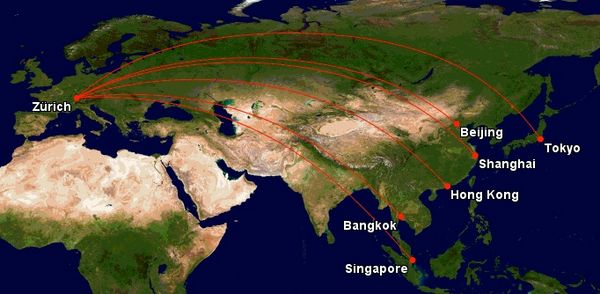
10.  SWISS

You can fly from Zurich to:
United Asia Miles
You Can Fly From Zurich On SWISS To These Cities In Asia
  • Bangkok
  • Beijing
  • Hong Kong
  • Shanghai
  • Singapore
  • Tokyo (Narita)

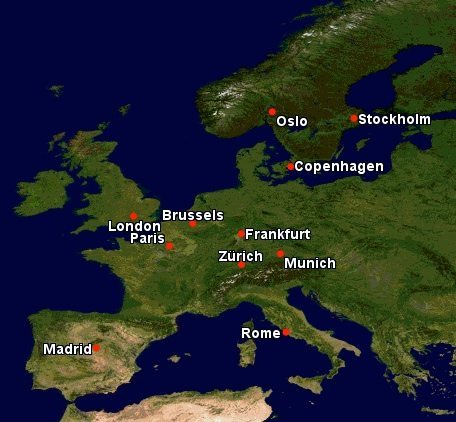
11.  Thai Airways

You can fly to Bangkok from:
United Asia Miles
You Can Connect In These Cities In Europe To A Thai Airways Flight To Bangkok
  • Brussels
  • Copenhagen
  • Frankfurt
  • London-Heathrow
  • Madrid
  • Munich
  • Oslo
  • Paris
  • Rome
  • Stockholm
  • Zurich

Bottom Line

You can use your United miles to fly to Asia on United or a Star Alliance partner such as Air China or ANA.
You can even fly to Asia via Europe and add a stopover on a roundtrip!

Sources: 
http://millionmilesecrets.com/2013/11/18/united-asia-miles/
http://www.gcmap.com